
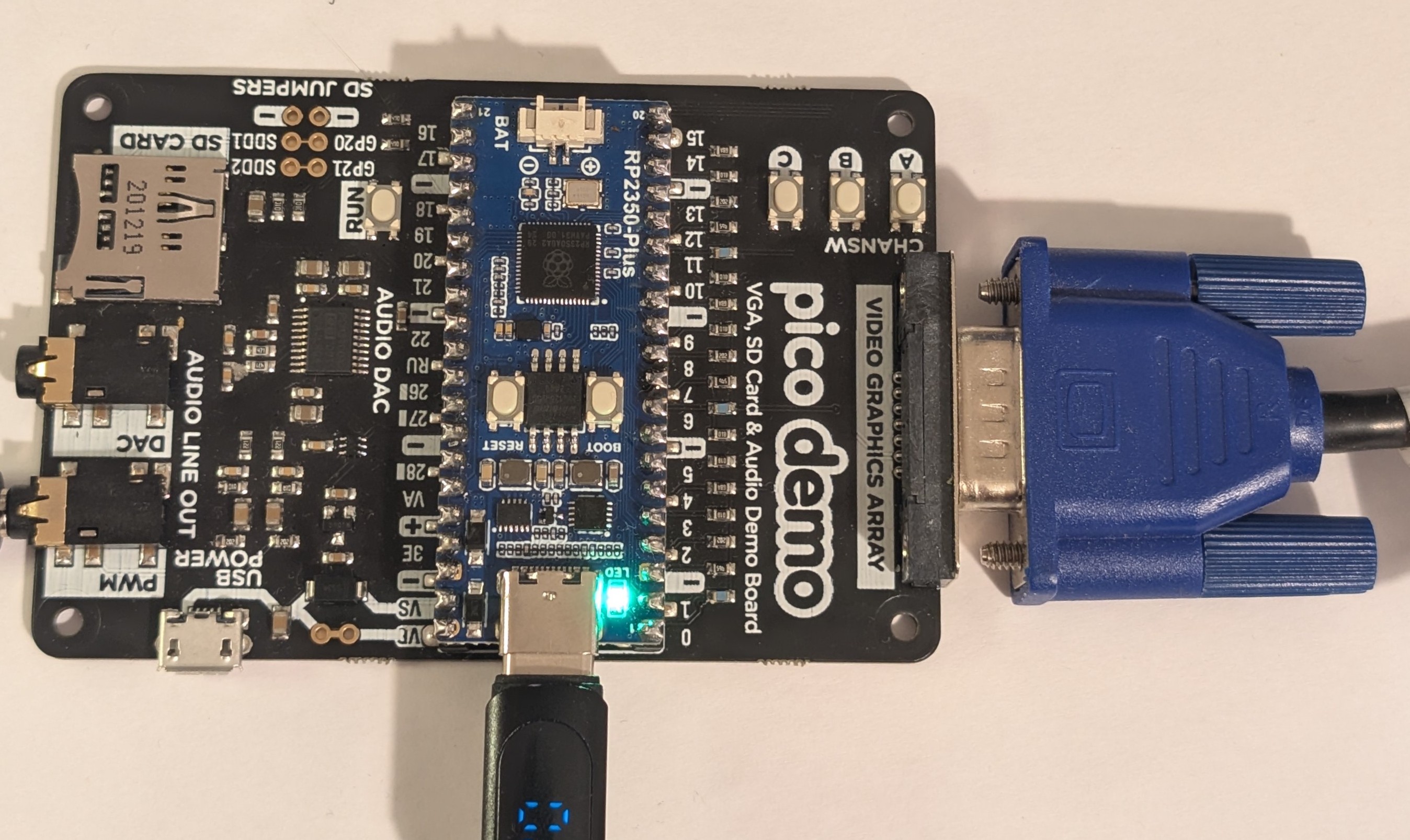

I finally got around completing a long pending project idea: A diffusion image generation model implemented on a microcontroller. See blog article and repo.
I finally got around completing a long pending project idea: A diffusion image generation model implemented on a microcontroller. See blog article and repo.
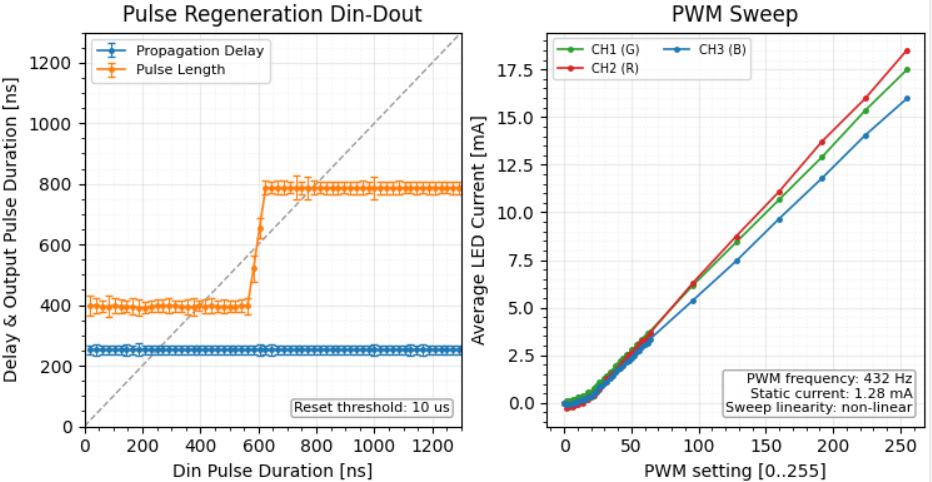
Now, over the course of more than a decade, I spent quite some time manually investigating WS2812 addressable RGB LEDs and their clones. Why not automate this?
The CH32V003 is ideally suited for this task, as it offers 5V compatibility and high resolution timers with DMA that can generate testing signals and evaluate the response. There are still some rough edges, but I will keep this as a quick hack for now.
Take a look at the full repository here and a high level summary of my findings here.

Building wireframe polyhedra made from LED filaments, using graph theory to devise geometry and driving strategies.
I relocated my blog to Hugo due to easier maintainance and more control over content and layout. You can find it here.
All articles from this blog have been preserved, although I won’t list some that I found lacking in quality.

Combining a deep-depthwise CNN architecture with variable quantization in BitNetMCU achieves state-of-the-art MNIST accuracy on a low-end 32-bit microcontroller with 4 kB RAM and 16 kB flash.
Read the article at my new blog location.

Todays candles have been optimized for millenia not to flicker. But it turns out when we bundle three of them together, we can undo all of these optimizations and the resulting triplet will start to naturally oscillate. A fascinating fact is that the oscillation frequency is rather stable at ~9.9Hz as it mainly depends on gravity and diameter of the flame.
We use a rather unusual approach based on a wire suspended in the flame, that can sense capacitance changes caused by the ionized gases in the flame, to detect this frequency and divide it down to 1Hz.
Continue reading “Candle Flame Oscillations as a Clock”LED-based festive decorations are a fascinating subject for exploration of ingenuity in low-cost electronics. New products appear every year and often very surprising technology approaches are used to achieve some differentiation while adding minimal cost.

This year, there wasn’t any fancy new controller, but I was surprised how much the cost of simple light strings was reduced. The LED string above includes a small box with batteries and came in a set of ten for less than $2 shipped, so <$0.20 each. While I may have benefitted from promotional pricing, it is also clear that quite some work went into making the product cheap.
Continue reading “A surprising IC in a LED light chain.”
Going along with implementing a very size optimized neural network on a 3 cent microcontroller I created an interactive simulation of a similar network.
You can draw figures on a 8×8 pixel grid and view how the activations propagate through the multi-layer perception network to classify the image into 4 or 10 different numbers. You can find the visualizer online here.
Continue reading “Neural Network Visualization”Bouyed by the surprisingly good performance of neural networks with quantization aware training on the CH32V003, I wondered how far this can be pushed. How much can we compress a neural network while still achieving good test accuracy on the MNIST dataset? When it comes to absolutely low-end microcontrollers, there is hardly a more compelling target than the Padauk 8-bit microcontrollers. These are microcontrollers optimized for the simplest and lowest cost applications there are. The smallest device of the portfolio, the PMS150C, sports 1024 13-bit word one-time-programmable memory and 64 bytes of ram, more than an order of magnitude smaller than the CH32V003. In addition, it has a proprieteray accumulator based 8-bit architecture, as opposed to a much more powerful RISC-V instruction set.

Is it possible to implement an MNIST inference engine, which can classify handwritten numbers, also on a PMS150C?
Continue reading “Neural Networks (MNIST inference) on the “3-cent” Microcontroller”The CH32V203 is a 32bit RISC-V microcontroller. In the produt portfolio of WCH it is the next step up from the CH32V003, sporting a much higher clock rate of 144 MHz and a more powerful RISC-V core with RV32IMAC instruction set architecture. The CH32V203 is also extremely affordable, starting at around 0.40 USD (>100 bracket), depending on configuration.
An interesting remark on twitter piqued my interest: Supposedly the listed flash memory size only refers to a fraction that can be accessed with zero waitstate, while the total flash size is even 224kb. The datasheet indeed has a footnote claiming the same. In addition, the RB variant offers the option to reconfigure between RAM and flash, which is rather odd, considering that writing to flash is usually much slower than to RAM.


