I relocated my blog to Hugo due to easier maintainance and more control over content and layout. You can find it here.
All articles from this blog have been preserved, although I won’t list some that I found lacking in quality.
I relocated my blog to Hugo due to easier maintainance and more control over content and layout. You can find it here.
All articles from this blog have been preserved, although I won’t list some that I found lacking in quality.

Combining a deep-depthwise CNN architecture with variable quantization in BitNetMCU achieves state-of-the-art MNIST accuracy on a low-end 32-bit microcontroller with 4 kB RAM and 16 kB flash.
Read the article at my new blog location.
Todays candles have been optimized for millenia not to flicker. But it turns out when we bundle three of them together, we can undo all of these optimizations and the resulting triplet will start to naturally oscillate. A fascinating fact is that the oscillation frequency is rather stable at ~9.9Hz as it mainly depends on gravity and diameter of the flame.
We use a rather unusual approach based on a wire suspended in the flame, that can sense capacitance changes caused by the ionized gases in the flame, to detect this frequency and divide it down to 1Hz.
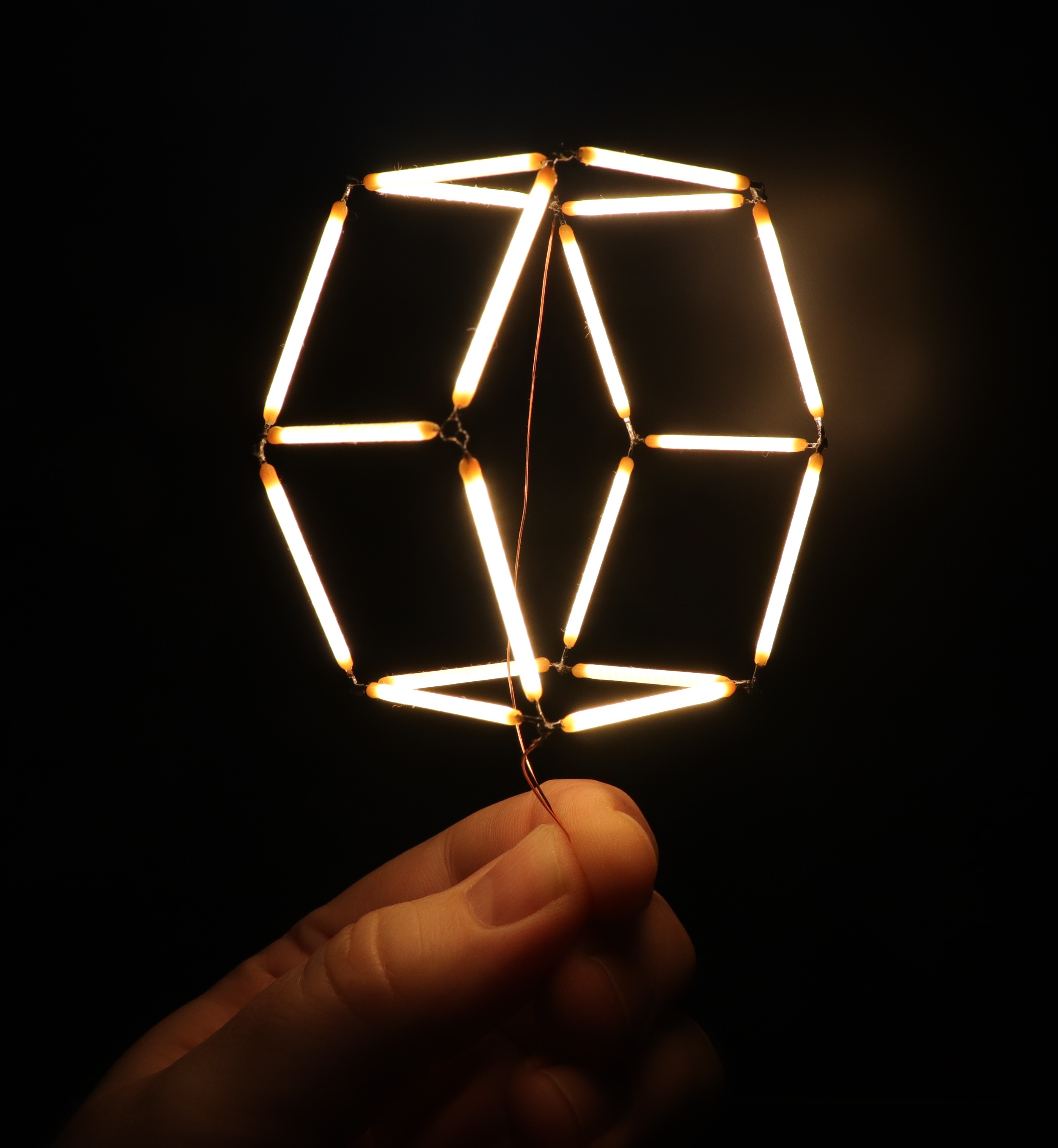
Continue reading “Candle Flame Oscillations as a Clock”LED-based festive decorations are a fascinating subject for exploration of ingenuity in low-cost electronics. New products appear every year and often very surprising technology approaches are used to achieve some differentiation while adding minimal cost.

This year, there wasn’t any fancy new controller, but I was surprised how much the cost of simple light strings was reduced. The LED string above includes a small box with batteries and came in a set of ten for less than $2 shipped, so <$0.20 each. While I may have benefitted from promotional pricing, it is also clear that quite some work went into making the product cheap.
Continue reading “A surprising IC in a LED light chain.”
Going along with implementing a very size optimized neural network on a 3 cent microcontroller I created an interactive simulation of a similar network.
You can draw figures on a 8×8 pixel grid and view how the activations propagate through the multi-layer perception network to classify the image into 4 or 10 different numbers. You can find the visualizer online here.
Continue reading “Neural Network Visualization”Bouyed by the surprisingly good performance of neural networks with quantization aware training on the CH32V003, I wondered how far this can be pushed. How much can we compress a neural network while still achieving good test accuracy on the MNIST dataset? When it comes to absolutely low-end microcontrollers, there is hardly a more compelling target than the Padauk 8-bit microcontrollers. These are microcontrollers optimized for the simplest and lowest cost applications there are. The smallest device of the portfolio, the PMS150C, sports 1024 13-bit word one-time-programmable memory and 64 bytes of ram, more than an order of magnitude smaller than the CH32V003. In addition, it has a proprieteray accumulator based 8-bit architecture, as opposed to a much more powerful RISC-V instruction set.

Is it possible to implement an MNIST inference engine, which can classify handwritten numbers, also on a PMS150C?
Continue reading “Neural Networks (MNIST inference) on the “3-cent” Microcontroller”The CH32V203 is a 32bit RISC-V microcontroller. In the produt portfolio of WCH it is the next step up from the CH32V003, sporting a much higher clock rate of 144 MHz and a more powerful RISC-V core with RV32IMAC instruction set architecture. The CH32V203 is also extremely affordable, starting at around 0.40 USD (>100 bracket), depending on configuration.
An interesting remark on twitter piqued my interest: Supposedly the listed flash memory size only refers to a fraction that can be accessed with zero waitstate, while the total flash size is even 224kb. The datasheet indeed has a footnote claiming the same. In addition, the RB variant offers the option to reconfigure between RAM and flash, which is rather odd, considering that writing to flash is usually much slower than to RAM.


I have been meaning for a while to establish a setup to implement neural network based algorithms on smaller microcontrollers. After reviewing existing solutions, I felt there is no solution that I really felt comfortable with. One obvious issue is that often flexibility is traded for overhead. As always, for a really optimized solution you have to roll your own. So I did. You can find the project here and a detailed writeup here.

It is always easier to work with a clear challenge: I picked the CH32V003 as my target platform. This is the smallest RISC-V microcontroller on the market right now, addressing a $0.10 price point. It sports 2kb of SRAM and 16kb of flash. It is somewhat unique in implementing the RV32EC instruction set architecture, which does not even support multiplications. In other words, for many purposes this controller is less capable than an Arduino UNO.
Continue reading “Implementing Neural Networks on the “10-cent” RISC-V MCU without Multiplier”The WS2812 has been around for a decade and remains highly popular, alongside its numerous clones. The protocol and fundamental features of the device have only undergone minimal changes during that time.
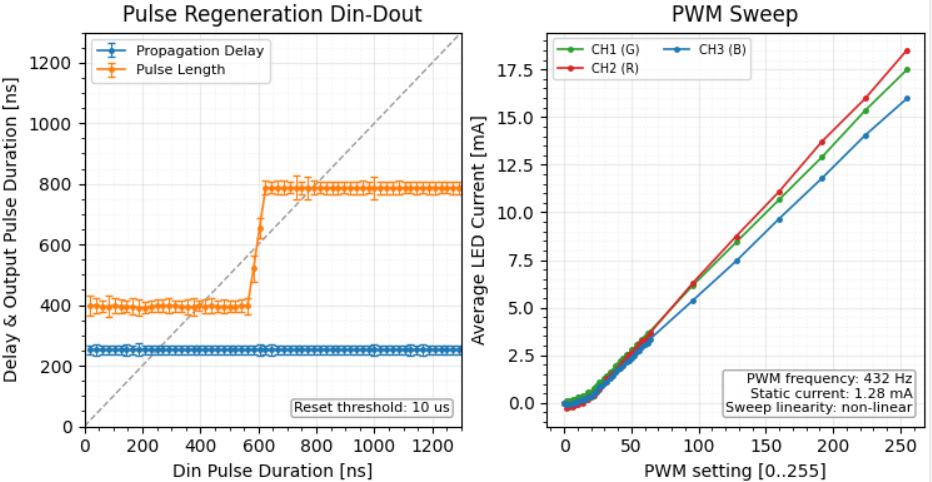
However, during the last few years a new technology dubbed “Gen2 ARGB” emerged for use in RGB-Illumination for PC, which is backed by the biggest motherboard manufacturers in Taiwan. This extension to the WS2812 protocol allows connecting multiple strings in parallel to the same controller in addition to diagnostic read out of the LED string.
Not too much is known about the protocol and the supporting LED. However, recently some LEDs that support a subset of the Gen2 functionality became available as “SK6112”.
I finally got around summarizing the information I compiled during the last two years. You can find the full documentation on Github linked here.

Years ago I spent some time analyzing Candle-Flicker LEDs that contain an integrated circuit to mimic the flickering nature of real candles. Artificial candles have evolved quite a bit since then, now including magnetically actuated “flames”, an even better candle-emulation. However, at the low end, there are still simple candles with candle-flicker LEDs to emulate tea-lights.
I was recently tipped off to an upgraded variant that includes a timer that turns off the candle after it was active for 6h and turns it on again 18h later. E.g. when you turn it on at 7 pm on one day, it would stay active till 1 am and deactive itself until 7 pm on the next day. Seems quite useful, actually. The question is, how is it implemented? I bought a couple of these tea lights and took a closer look.