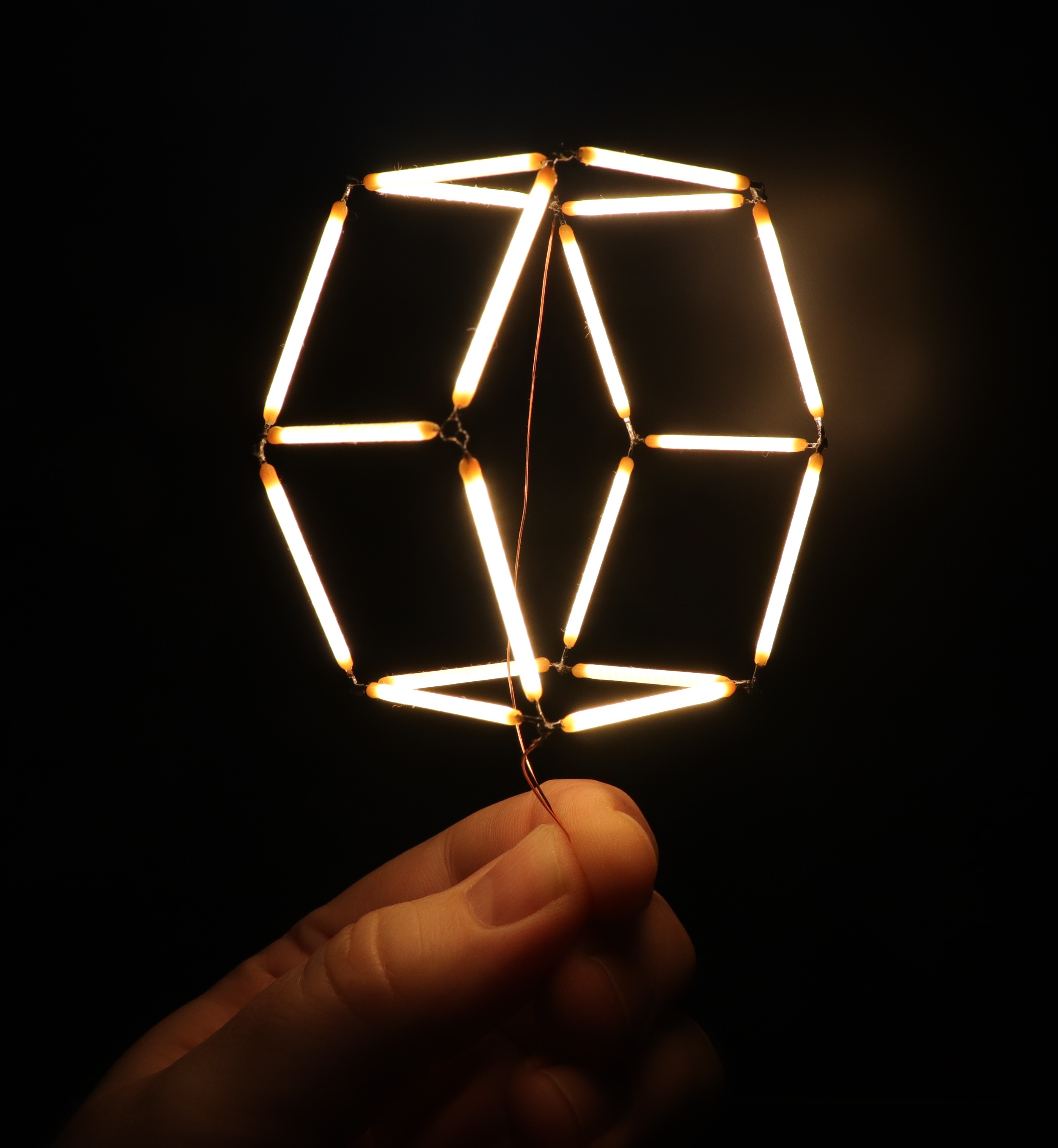
Building wireframe polyhedra made from LED filaments, using graph theory to devise geometry and driving strategies.
Building wireframe polyhedra made from LED filaments, using graph theory to devise geometry and driving strategies.
Years ago I spent some time analyzing Candle-Flicker LEDs that contain an integrated circuit to mimic the flickering nature of real candles. Artificial candles have evolved quite a bit since then, now including magnetically actuated “flames”, an even better candle-emulation. However, at the low end, there are still simple candles with candle-flicker LEDs to emulate tea-lights.
I was recently tipped off to an upgraded variant that includes a timer that turns off the candle after it was active for 6h and turns it on again 18h later. E.g. when you turn it on at 7 pm on one day, it would stay active till 1 am and deactive itself until 7 pm on the next day. Seems quite useful, actually. The question is, how is it implemented? I bought a couple of these tea lights and took a closer look.

A while ago, I used transient current analysis to understand the behavior of the WS2812 a bit better (and to play around with my new oscilloscope). One intersting finding was that the translation of the 8 bit input value for the PWM register is mapped in a nonlinear way to the output duty cycle. This behavior is not documented in the data sheet or anywhere else. Reason enough to revisit this topic.


As should be obvious from this blog, I am somewhat drawn to clever and minimalistic implementations of consumer electronics. Sometimes quite a bit of ingeniosity is going into making something “cheap”. The festive season is a boon to that, as we are bestowed with the latest innovation in animated RGB Christmas lights. I was obviously intrigued, when I learned from a comment on GitHub about a new type of RGB light chain that was controlled using only the power lines. I managed to score a similar product to analyze it.
Continue reading “Controlling RGB LEDs With Only the Powerlines: Anatomy of a Christmas Light String”
Sometimes you find things you have not even been looking for…
A chaotic oscillator is an electronic circuit that can exhibit “chaotic“, nonperiodic behavior. A commonly cited example is Chua’s circuit, but there are many others. I always regarded these as carefully designed, rather academic, examples. So I was a bit surprised to observe apparently chaotic behavior in a completely unrelated experiment.
Continue reading “Building a Chaotic Oscillator from Common Components”I recently bought a very low cost electronic dice kit on an impulse. Assembling it was good retro-fun for a while. The circuit design is was purely 70ies style: A CD4017, a NE555 and a couple of transistors. Of course, this got me thinking: How would it be done today in a most efficient way? Of course this means using a microcontroller, and, of course this means using as few resources as possible. Will an ATiny10 with 3 I/Os pins do?
Continue reading “How many I/Os are needed to drive electronic dice?”
A couple of weeks ago I reported about a new type of RGB-LED with integrated controller, the APA102. One of the interesting new features of this device is a two-wire SPI interface instead of the proprietary one-wire protocol of the more common WS2812. Many microcontrollers have hardware SPI functions, which allow easy control of these LEDs, as opposed to timing critical bit banging. But it turned out this was not the end of the story. As pointed out by Bernd in a comment, there is some discrepancy between the datasheet and the actual behavior of the devices when it comes to the “end frame”. Reason enough to subject the APA102 to more scrutiny.
The diagram below summarizes the APA102 protocol as found in the data sheet.
After clones and variations of the venerable WS2812, there finally seems to be a new RGB-LED with integrated controller that actually improves on several characteristics: The APA102, also known as “Superled”. There are two versions on the market, the APA102 and the APA102C, as shown below.
The WS2812 RGB LEDs with integrated controller are fairly successful devices that come in a variety of packages. Recently, similar devices by other manufacturers started to appear.
I managed to get my hands on a few samples of LEDs with PD9823 controller, courtesy of Soldering Sunday, and was able to subject them to more scrutiny. The manufacturer of the IC seems to be “BaiCheng”. You can find it in several LEDs with different package types. There is a single page “datasheet”, linked here, but little else is known to me.
The given timing values are, again, completely different from any other device. So are these really compatible to the WS2812? Only one way to find out: I used the same setup to extract the timing as described earlier for the WS2812. You can find the results below.

Atmels AVR ATtiny10 are surprisingly powerful devices that come in an extremely tiny SOT23 package with only 6 pins. The have 1kb of flash, 32 bytes of SRAM and use the reduced AVR core which only supports 16 instead of 32 register. It seems like Atmels idea of these devices is to use them as an advanced blinker, and to replace tiny logic circuits. But other people have shown that much more is possible. For example the noiseplug (video), a chiptune player, and a Simon Says game.
I previously used the ATtiny10 in the TinyTouchbutton, a touchbutton controlled light with WS2812 LEDs. This time I aimed higher: Is it possible to turn the ATtiny10 into a USB compatible device? My goal was to implement a subset of the little-wire functionality to control a WS2812 LED by USB. This takes 3 I/O lines, which is exactly the number of free pins on the ATtiny10.
Littlewire supports several functions to control WS2812 LEDs on arbitrary I/O ports. I simplified this to only supporting a single LED on a specific pin, however still retained protocol compatibility. This means that all the little-wire host-programs still work. The finished device can, for example, be used as an RGB indicator LED similar to the Blink(1).
My test setup is shown below. The ATtiny10 is almost the smallest part of the circuit. There are some discrete components on the rear-side of all PCBs, so do not be surprised about missing decoupling capacitors, zener diodes and resistors.


 Tim's Blog
